Here's my Google Scholar (800+ Citations)
Here's My ResearchGate (560+ citations)
My PhD is in Instructional Systems Technology with a double minor in Library & Information Science and Telecommunications from Indiana University. My primary research home at Indiana was the Institute for Communications Research then headed by the amazing Dr. Annie Lang. That is where I learned to measure skin conductance, facial EMG, and other aspects of human psychophysiological reaction to media. I love to point out that they had to re-calibrate much of their equipment when I brought in video gamers, they had never seen reactions as strong. I also learned survey research and traditional library science research methods.
The Telecommunications department at Indiana switched from a qualitative focus to a quantitative one while I was there. This meant early on I was able to take classes on critical analysis from scholars such as Dr. Ellen Seiter and Dr. Dwight Brooks. Graduate school was an amazing intellectual and scholarly time in my life, and I have been well served career-wise by the intellectual diverse path I wandered on. I was even lucky enough to be at Indiana during the formation of the School of Informatics. The main Irish scholar behind the iSchool movement used to come to parties at my house. I lived with Jazz Performance majors, it was amazing.
During that graduate work I was speaking with a friend whose spouse was in the final stages of a double PhD in the humanities. It was paper application days, that person sent out 99 perfect, customized applications for faculty jobs. Right down to a self-addressed and stamped postcard in each one to prove successful delivery.
That person did not get one phone interview. As I was enjoying myself during doctoral study I hate to admit until that point I never considered how hard the job market was. I applied for two jobs while ABD as a test and got a tenure track position at East Stroudsburg University in the Poconos of Pennsylvania. A cute little regional state campus. I taught four classes my first semester.
The problem is that I love research, but did not really have a position that left much room for me to keep a heavy research agenda. As the majority of schools where I have taught are student focused, I decided that a research agenda aimed at doing research alongside students made the most sense. As I have been tasked to teach a range of technology classes across my career I chose to take students to a wide range of conferences. These conferences are often major media events depending on the context where I was working and student interest.
With no startup money at any faculty position, a huge teaching load and travel support for one conference a year I have managed to make repeated presentations at very competitive outlets. I have presented at Game Developers Conference three times. I have presented at the academic part of San Diego Comic Con four times. I spoke with students at Disney's Star Wars Celebration. When I had graphics-focused students I presented with them at ACM SIGGRAPH. I presented research at an academic Conference associated with Tokyo Gameshow and I have given research talks at at least a dozen universities in China as a part of an international recruitment program. I made a 3D visualization tool in the context of Anscombe's Quartet with a student and talked about it at ASIS&T. I also have given scores of traditional academic presentations at academic organizations like AECT and IVLA.
My latest research efforts reflect the intellectual freedom in my position.
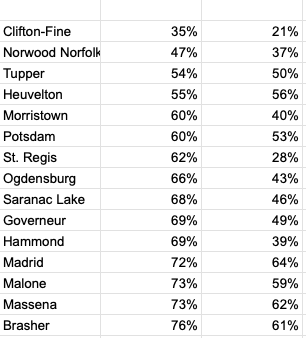
I have severe concerns for the future of rural America, schools in my home region of Northern New York are often half the size they were when I graduated high school.
The numbers above are High Schools in New York's largest county, St. Lawrence. The first row is how much smaller the school is from 30 years ago. The next column represents the smaller graduating class currently in the school compared to 30 years ago. For example Clifton Fine used to graduate around 50 students, now it graduates around 15 and has classes of 10.
I feel there are perception problems hiding the scale of the issue from people, so I am working on a data analysis of schools in the North Country of New York. I am working on this data in a way meant to maximize citizen understanding of the problem. There has been some very good reporting on the issue, but the data has not been presented in ways that help people understand how it impacts them. I have policy ideas based on my experiences that I feel could potentially change trends.
My second research project is completely different. I teach a class on Experience Design for the Park School. The basic scholarly definition of Experience Design is "interactions over time". I want the toy industry to apply Experience Design concepts to their product lines. I am using data collected on a Strong Museum of Play fellowship for my next research stage.